Is the over optimising culture hurting us?

This week’s post is a bit off track again. Maybe it’s the time of year and I’m feeling reflective, but something’s been getting at me for the last few months, and I thought it was worth a few words.
Has the search for over-optimisation backfired on society?
Might seem a big claim but it just seems that between personal experience, what I see in the world and what media is getting clicks, it seems we have an issue. Or at least I do.
Remember when podcasts really took off? A way to find the exact kinds of news and insights you were keen on. Originally, it felt fresh—a way to learn on your own time, without the gatekeepers of traditional media controlling what you heard, when, and for how long.
For me, the first podcasts I really enjoyed were The Guardian Football Weekly—a simple, fun way to get all the football news twice a week—then Rich Dad Radio Show with Robert Kiyosaki (which quickly fell by the wayside because there are only so many times I can hear a rich man cry wolf), the Hospital Records podcast (a British drum and bass label), and of course a few Swansea City podcasts.
Along the way, it felt like a few big podcasters came into play and we started heading down a path dominated by a handful of voices. Joe Rogan had some genuinely interesting guests, which helped propel him to global fame, including Elon Musk—before heading down all kinds of vaccine rabbit holes. Then there were people like Rich Roll, offering new ways of thinking about health and wellness, alongside familiar faces like Kelly Slater and Chris Burkard bringing an outdoors perspective.
Friends started podcasts too. Matt Barr’s Looking Sideways—now with over 250 episodes unpacking the stories of action sports and “other related endeavours”—has long been a weekly highlight, especially his recent series The Announcement, focused on Patagonia and the decision to make Earth its main shareholder.
More recently, I’ve enjoyed the business overview from Scott Galloway. He has some genuinely sharp insights into how big tech is damaging our health, and his TED Talk on how the US is destroying young people’s futures is well worth watching:
Then, over the last couple of years, we’ve seen the rise of Stephen Bartlett with The Diary of a CEO and Chris Williamson with Modern Wisdom.
At first, both felt insightful. Useful. A bit of a breath of fresh air. You could genuinely learn something new.
But more recently, it feels like—especially in Stephen Bartlett’s case—we’ve gone deep into clickbait territory. The tips and tricks we were learning have become, to me, anxiety-driving. It feels like every episode is about optimising your life.
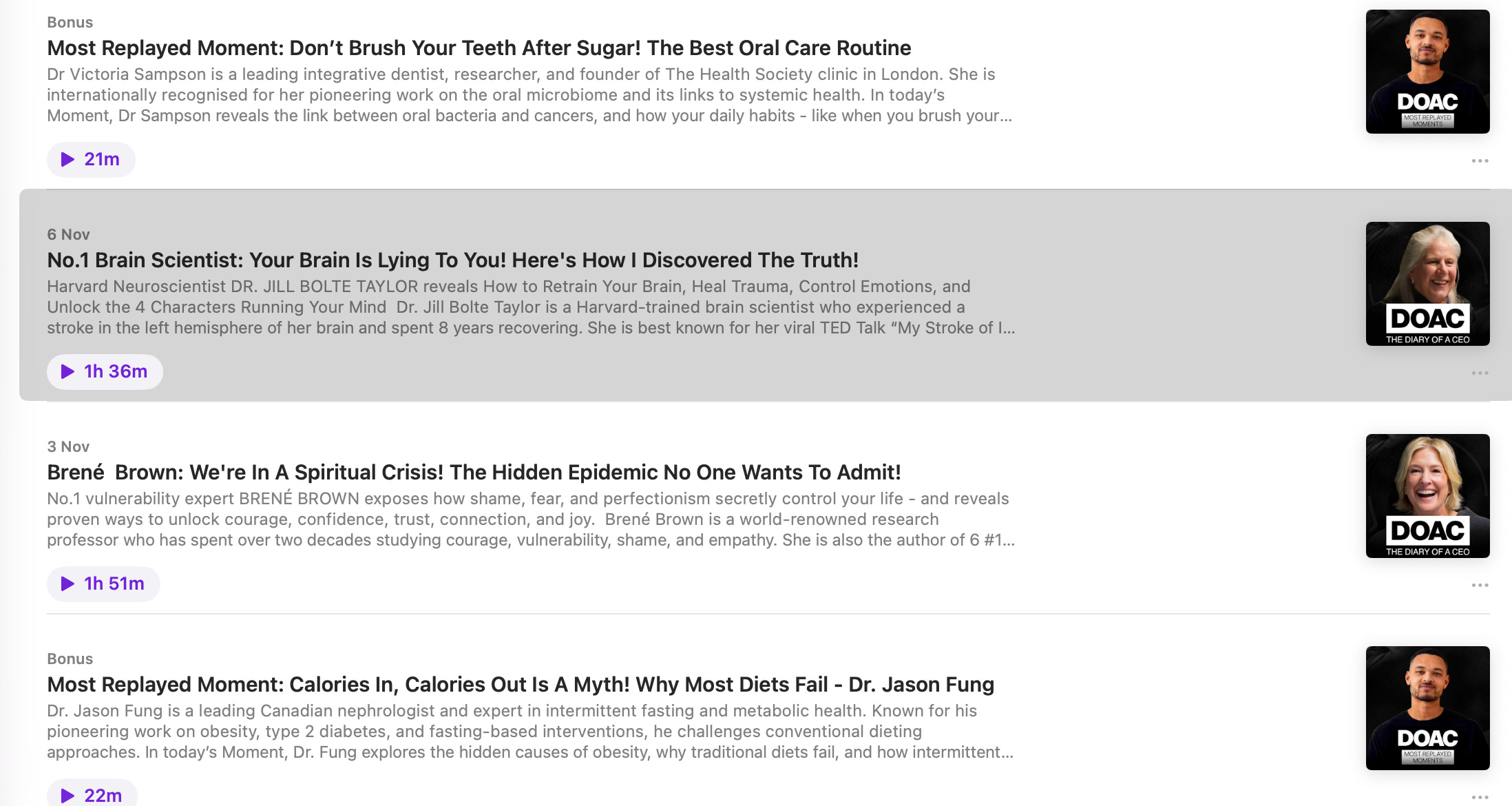
Anyone else tired?
While it’s all well-intentioned, it increasingly feels like no matter what we do, it’s never enough. We aren’t optimising everything. And that sense of pressure seems common across all ages right now.
The intent is to help, but it feels like we’ve gone full circle and it’s now hindering listeners at scale.
The number of people I know who seem to be struggling is genuinely alarming, and so much of it comes back to the same question: Am I doing enough?
When I talk to people dealing with this, I always say the same thing. I didn’t really start working until 25. I didn’t make any real money until 30. I wrote my first book at 40.
The problem is for many people there is this weird feeling that if you don’t have life figured out at 26—with a six-pack, loads of money, your own apartment, sleeping eight hours a night (after making sweet, perfect love to your partner), then waking up for an ice bath before smashing out a half marathon—it can feel like you’re failing at life.
The real challenge is that what’s supposed to be helping is actually harming right now.
It all goes back to the saying “comparison is the thief of joy.” It once felt like Instagram was the main culprit. Now it’s invaded what used to feel like a sacred space: podcasting. These platforms have become ground zero for doubting our own abilities, endlessly serving up the same style of content through the algorithm until, before you know it, you’re thinking, I am so far behind.
To combat this, I started using Opal—an app that blocks social media at certain times of day so you can focus, and yes, stop checking Instagram as the first damn thing you do in the morning. I’ve also stopped switching my phone on at all on Sundays. Two weeks in. So far, so good. Great, in fact. Try it.
I went for a run this morning with someone from my team at work, and I was genuinely surprised by how happy he was.
“I work with great people. We’re trusted to do meaningful work. And when I think about where we all started and where we came from, I’m just really happy and proud.”
As we ran, I reflected on two things:
a) how well-adjusted this guy is, and how grateful I am to work with him;
b) how different this felt from the general mood right now.
There seems to be a lot of frustration around, and to me this feels like one of the clearest triggers: we all feel like we aren’t doing enough. So we dig some more. Try to do more.
But when I look at young people today, I see a generation that’s smarter than I could ever hope to be. They have skills across multiple platforms and apps. They drink less than the generation before did. They think running is a fun thing to do together. They eat well.
When I see this same group doubting themselves, it honestly feels like they just need reassurance that they’re doing things in the right order—and that success will come.
Sometimes, in the constant search for optimisation, we forget how far we’ve come.
My grandfather wrote a book about his time in the Second World War. That’s only two generations before us. He was awarded the Military Cross for his time with the Royal Fusiliers, particularly in Italy during the Battle of Monte Cassino, where his “grim tenacity of purpose and sheer determination to surmount every obstacle in 48 hours’ continuous fighting led to a significant victory for Allied forces.”
Nowadays, if I haven’t slept eight hours, done some yoga, and hit my protein target by breakfast, it can feel like the day is already a write-off. I go back sometimes and think how only two generations ago getting a warm shower, meal and not being shot at would have seemed like a good day.
It’s worth reflecting sometimes on how good we have it.
I’m certainly guilty of this. Once I lock into a rhythm, I don’t love slipping out of it. They say routine leads to success—but sometimes sacking it off to go for a couple of beers after work is exactly what’s needed to break the spell of this culture.
So what’s the takeaway?
You’re probably doing enough. You’re likely curious. You care. You want to learn.
Everything else is a bonus.
So, if we are talking about podcasts, what am I trying to listen to now?
Well, more of the the ones which I feel are helping. That and ones which make me laugh. One for me is the Socially Distant Sports Bar which is a welsh podcast loosely based on football. A perfect hour every week to take your mind away. This is an excerpt from an episode with a very funny story about Wimbledon that a listener animated for them. So good..
It’s why I can’t listen to those podcasts tbh. Ave a day off lads